< Technology >
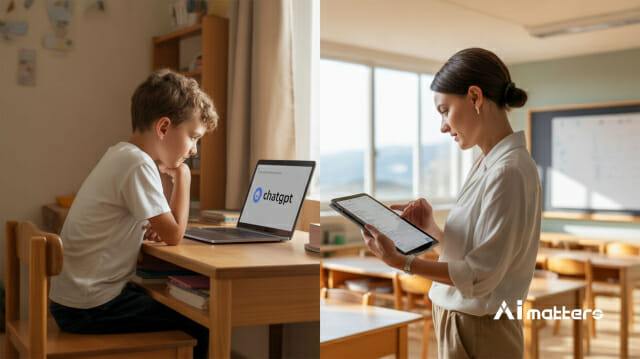
"Today, I'll write while practicing writing with ChatGPT" is a phrase heard in high school classrooms these days. Even in classrooms, lessons using artificial intelligence (AI) are becoming more prevalent. Students are using AI to get feedback for writing, find debatable topics, and to repair pr onunciation in foreign language classes. But does this shift actually provide higher quality of learning, or does this take away from our ability to think?
ZDNet reports that in South Korea, there is a trend of teachers using AI to help support personalized learning. Systems can automatically analyze a student's level and weaknesses to show appropriate problems or give pronunciation feedback while practicing English conversation to provide individualized education." The Korea Economic Daily described it as an AI-based education platform that can analyze student achievement in real time and give feedback to teachers. Many positively evaluate this because it reduces teachers' workloads and encourages more customized feedback for student thinking.
There is an increasing number of students incorporating AI as a resource for learning. I spoke to a student from a foreign language high school to understand what he thought. He says he looks up basic questions of his major language and uses AI to help him out.
“When I encounter difficult words or grammar, I just look at AI. Before, I would not understand even when I used the dictionary, but AI explains the context and gives examples, so I learn much faster.”
He claimed that AI simply speeds up and makes it convenient. Still, there are people who are pointing out that easier access to learning answers could impair deep thinking. For example, JTBC reported that some students are experiencing "diminished thought" because they take AI's answer as a given. To provide more insight into students' perceptions of AI learning, I surveyed 50 students from both foreign language high school and regular high school students. The survey consisted of questions about whether any AI technology had previously provided inaccurate answers to students’ questions or if they thought their thinking time decreased when using AI.
The findings indicated that 68% of respondents had "encountered AI mistakes." Many stated that AI had provided wrong explanations for grammar or translations, or had otherwise offered incorrect information. In addition, 60% of students said that they encountered AI mistakes, stating that "thinking skills appear less strenuous with more integration of AI." On the other hand, 40% cited positives indicating that "AI helps quickly organize concepts." The results thus suggest a duality of "efficiency" and "thinking capacity" revealed during the AI learning experience. The Korea Industrial Daily (KIDD) reported, when solving grammar errors, "answers may be correct but take away the understanding of the process." The report means that students are creating habits of reporting results while taking away any possible use of thinking the problem out for themselves, potentially resulting in weakened "critical thinking skills" over time.
AI has almost certainly brought about innovation. However, education is not just a machine to be programmed, but a garden where understanding grows through human connection. If the process of kids asking questions, examining, and learning by making mistakes ceases to exist, no amount of advanced technology will replace real learning. AI should be a co-existing with teachers, not a competitor. Behind all the convenience of AI, Still exists the fact that we are human beings that constantly think about and have an ethical obligation regarding the content of education. Future classrooms should not be "place where AI is teaching," but "spaces where we learn with AI."
By Staff Reporter Kim Hayoon (2-1)
'Opinion' 카테고리의 다른 글
| Beyond the Screen: How Media Creates Our Reality (0) | 2026.02.03 |
|---|---|
| In the OTT Era, What Are Theaters Really for? (0) | 2026.02.03 |
| OTT Exclusive Broadcasts Threaten the Public Nature of Sports (0) | 2026.02.03 |
| Digital Influencers Redefine Youth Identity and Consumer Culture (0) | 2026.02.03 |
| In The Age of Social Media, Is International Public Opinion Truly ‘International’? (0) | 2026.02.03 |


