Student’s lack of knowledge on how to write study planners
‘Study Planners’ are known to be helpful in efficiently in organizing time and tasks. It is a widely recommended way to make studying productive and increase academic achievement. Drawn to this recommendation, many students attempt to write one on their own and hope for a more productive study life. However, not all of them succeed in writing an efficient planner, and some even give up on it because they have difficulty sticking to the plan or simply assume that writing planners doesn’t work for them.
Staff reporters of TRIBUNE conducted a survey targeting MCH students to find out how they are using study planners. Of the 70 students who responded, 46 students (66.7%) said they use study planners or to-do lists to organize their studying. However, among these students, only 62.5% responded that they put more than 80% of their plans into action, while the rest said they put less than 50% of their plans into action. Moreover, 23 students (33.3%) said they don't use study planners or to-do lists at all. When asked to give a reason, 40% said it’s because even if they make plans, they don’t put them into practice anyway. Others responded that they either don’t know a good way to establish plans with a planner or think using planners doesn’t suit them. This result shows how MCH students experience difficulty in using study planners. The implementation rate of their plans isn’t high in general, and many students don’t create study planners because of a lack of knowledge in how to write one.
To solve this problem, staff reporters of TRIBUNE interviewed two MCH students who make good use of study planners. This interview aims to guide MCH students to write more efficient and productive study planners of their own through best practices provided by these two students.
Interview with Jaehui Ko
Q1. Please introduce yourself.
A1. Hello, my name is Jaehui Ko, I’m in the 1st grade, in class 7.
Q2. When did you start writing your study plan and what motivated you to do so?
A2. I started writing a plan in the first year of middle school because my homeroom teacher bought me one saying that it was a great way to manage my time.
Q3. Please introduce us to your method of using a planner.
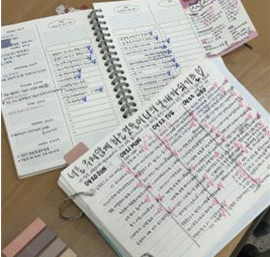
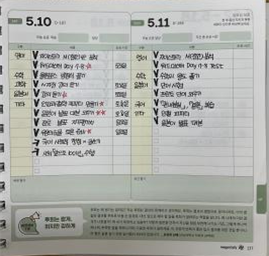
A3. I do things a little differently. First, I plan for a month, then I plan for a week within that month, and then I write a daily planner from that. Marking the important things with a star, the things that I failed to do with an ‘x’, those half done with a triangle, and things that need to be moved to the next day with an arrow. Using these marks helps me easily identify where I am with my plans.
Q4. What are the advantages and disadvantages of your method of using a planner?
A4. The advantage is that I live an efficient life by planning on a monthly basis. On the other hand, I often feel low in energy because I’m doing too many productive activities.
Q5. When you have a study plan in place, what percentage of it do you take action on? And what are your tips for increasing action rates?
A5. Sometimes it's 100% when I'm doing well, and when I'm not doing well, it's probably around 75%. I think my tips for increasing my action rates are to make good use of self-study time, and if I'm not going to be able to complete my plan, I even use recess to finish it.
Q6. Do you have any advice for students who struggle with writing a planner?
A6. If you try to plan a month ahead like me, it can be very difficult, so I'd encourage you to take it slow and start with day-to-day plans until you get used to having, and following a plan.
Interview with Yeda Kim
Q1. Please introduce yourself.
A1. Hi. I'm Yeda Kim, a 2nd grade Spanish major at Michuhol Foreign Language High School.
Q2. When did you start writing your study plan and what motivated you to do so?
A2. I’ve always been a planner. It comes naturally to me. To prepare for exams, I began using a study planner more systematically. In second grade, when I was in middle school, I started sharing my planner on Instagram for about a year. During that time, I realized I could have a positive influence on others through my planner posts and I genuinely enjoyed the process.
Q3. Please introduce us to your method of using a planner.
A3. When it's not exam season, I use a weekly planning table and have a section for general weekly tasks. I organize plans like club schedules or assignments by subject, using different colors. That way I can easily refer back to them when creating detailed daily plans. On weekends, I look at my final weekly goals and categorize what I need to do, especially for focused study times. During exams, I prioritize urgent subjects and write down specific time slots to make my study schedule as efficient as possible.
Q4. What are the advantages and disadvantages of your own method of using a planner?
A4. I tend to work backwards; I set a final weekly goal first, then break it down into daily goals. This helps me stay on track and usually leads to a higher completion rate. Because everything is organized, I rarely miss anything, and I can get assignments done on the day I planned. As for the downside, especially right before exams, if I schedule everything hour by hour and can’t stick to it, the stress gets worse. But I’ve seen some of my friends plan out each study block by subject, like "1st session: math, 2nd session: science," and they manage time more efficiently that way. It made me think that it might be better to plan that way-not just during exams but regularly.
Q5. When you have a study plan in place, what percentage of it do you take action on? And what are your tips for increasing action rates?
A5. Honestly, I think I complete about 65–70% of my plans. I think it is because my strategy is to set slightly higher goals than what I think I can achieve during study sessions. So in a way, self-awareness is key—knowing how much you really can do. But to figure that out, you have to actually try doing more, not less. That’s why I believe consistently using a planner helps you measure your real capacity objectively. In that sense, writing a planner regularly might be the best tip to increasing your action rates.
Q6. Do you have any advice for students who struggle with writing a planner?
A6. I've noticed that some girls feel pressured to make their planners look good so they can show them to others. If they are not good at it, they get stressed and give up planning altogether. Some end up just doing whatever comes to mind without any structure. But I’d say—don’t stress about how it looks. Your planner is just for you, to help you study more efficiently. So instead, approach it with a mindset of "let's find a little motivation to do what I can today." Also, there are so many types of planners out there—choosing one that fits your style is really important. If you like detailed planning, go for one without time blocks. But if you prefer time-based efficiency, a planner with timelines will be easier to use from the start.
The need to find your unique way of writing study planners
Students Jaehui Ko and Yeda Kim represent great examples of establishing study plans using study planners. They also showed different ways of planning work for different people. Therefore, instead of imitating other’s ways of organizing, it would be wise to try various methods and create one that actually fits you.
By Staff Reporter Kim Yeyoung (1-7)
Park Yulim (1-7)
Kim Sua (2-8)
'Article' 카테고리의 다른 글
| Accent: Core of Translation (0) | 2025.10.11 |
|---|---|
| Bridging the Gap: Students’ Psychological and Linguistic Hurdles in Native Language Classrooms (0) | 2025.10.11 |
| How to Build Up a Good Student Record (0) | 2025.10.11 |
| School organizations striving for MCH: School Ambassadors, RAON, WEBS (0) | 2025.10.11 |
| Article for seamless school life for first graders (0) | 2025.10.11 |


